A State of Hope, an evening at Trinity Reperatory

A staged reading of "A State of Hope", Tom Roberts' powerful and moving play about the Great Famine (1845-1851), was performed on Monday, May 21, 2007 at 7:00 PM in the downstairs theater at Trinity Repertory, 201 Washington St., Providence, RI.  The following is excerpted from the program for this stirring and informative event.


“A STATE OF HOPE"
 
Written and Revised by Tom Roberts
Directed by Pat Hegnauer

Produced  By  Don  Deignan & Jeanne Chapman
Presented May 21, 2007 at 7:00 PM

In the Dowling Theater at the
Trinity Repertory Company

DIRECTOR: PAT HEGNAUER
(Four Actors, collectively, assume 45 different roles.  Most of the characters portrayed are composites but several are actual historical figures.  The words of all of them are taken directly from various documents dating from the period of the Great Famine.) 
 THE CAST
GERRY CAMPBELL................................... (VARIOUS MALE ROLES)
DONNA LUBRANO...................................... (VARIOUS FEMALE ROLES) 
MARILYN MEARDON................................. (VARIOUS FEMALE ROLES)
TOM O’DONNELL......................................... (VARIOUS MALE ROLES)

THE MUSICIANS

PHIL EDMONDS.................................................... (TIN WHISTLE &  BUTTON
                                                                                        ACCORDION)

MANCE GRADY..................................................... (BODHRAN)
TOM PERROTTI....................................................... (GUITAR) 
JACK WRIGHT.......................................................... (FIDDLE & BUTTON
                                                                                         ACCORDION)


A MESSAGE FROM RAY MCKENNA 
Dear Friends and Supporters,
 
It is a pleasure to share this wonderful evening with you.  Tonight’s performance of “A State of Hope” provides all of us with an opportunity to consider the experiences endured by our ancestors during On Gorta Mor, the Great Hunger.  The Irish Famine, perhaps the nineteenth century’s worst human catastrophe, brought the majority of the ancestors of today’s Irish-Americans to our shores.  As such, it is particularly important that we preserve and honor the history of the Famine and of the immigrant experience.
 
The one hundred fiftieth anniversary era of the Famine began in 1995 and lasted until 2001.  In November of 1995, Anne Burns, a founding member of the Rhode Island Irish Famine Memorial Committee (RIIFMC), arranged for a memorial Mass to be celebrated at the Cathedral of Saints Peter and Paul in remembrance of those who died in the Famine.  Over one thousand people attended the Mass and were moved by descriptions of courage and perseverance shown by our ancestors in the face of suffering and death.  Following the Mass, members of several Rhode Island Irish organizations began to discuss the importance of erecting a Famine Memorial in our state, as Irish people have done in Ireland and wherever they have settled in great numbers.
 
By early 1997, the RIIFMC was formally established and incorporated as a 501C3 nonprofit organization.  We began the search for a sculptor who could develop a concept and design that would pay tribute to those who suffered and died in the Famine.  We hoped the monument would also honor our immigrant ancestors who braved the Atlantic crossing and paved the way for our success.  After a nationwide search, the committee unanimously chose the design submitted by Robert Shure of Woburn, Massachusetts.  We were indeed fortunate in our choice, as Bob Shure has amassed an impressive body of work over the many years of his career, including the Boston Irish Famine Memorial and the Rhode Island Korean War monument.
 
Bob’s concept for our monument includes an impressive granite and bronze sculpture that portrays the suffering that took place during the Famine.  Equally important, it also expresses the strength and optimism of the Irish people.  The design incorporates a memorial wall that, in bas relief and on a narrative plaque, illustrates and relates the story of the Famine—the perilous Atlantic crossing and the immigrant experience.  The wall also lists the many contributions that Irish-Americans have made to our state and nation.  Bob Shure’s design will provide a moving affective and educational experience.    We hope those who visit the monument will reflect on the experience of our Irish ancestors who came to America for freedom and opportunity and joined with immigrants from around the world to build a great nation.  We look forward to dedicating the monument this September.
 
In closing, I would like to thank executive board member Don Deignan who, along with his sub-committee, made this evening possible.  I also want to acknowledge the ongoing support of honorary board members Joe Garrahy, Bill and Nancy Gilbane and Patrick Conley, as well as the RIIFMC members, whose years of work and dedication have helped to make this vision a reality.
 
Many thanks for your support!
 
Raymond J. McKenna
President
Rhode Island Irish Famine Memorial Committee, Inc. 


CRADLE OF HOPE by Tom Roberts
     
    At some point in our lives most of us wonder where we came from, how our families arrived in this country, this state, this town. For me it happened fifteen years ago, when I was losing my first-generation parents, aunts and uncles. All four of my Irish grandparents had emigrated and neither they nor their children had spoken much of where they came from or why.
 
    In the early 1990s I began my search for answers to those unanswered, sometimes unasked, questions. It took me through birth, marriage and death records, shipping manifests, citizenship forms, rectories and offices over here and over there, where they either embraced my curiosity or found me another thorn in their crown. My search produced a few “Eureka!” moments and even more frustrations. It still goes on.
 
    On a rainy afternoon in 1993 at 2nd Story Theatre, I shared shelter from a storm with another actor, Gerard Campbell.  Ten years earlier he had done what my grandparents had undertaken a century before, left Ireland and come to Rhode Island. From our damp conversation that day came an idea to create a play about the passage we shared in some time-warped way. Our investigation led us to the noted historian Kerby Miller, who had amassed thousands of letters from and to those daring Irish men and women who had risked everything on the hope that life across the ocean offered opportunities beyond the famine, disease and oppression that were their prospects at home.
 
     Some never made it to America.  Others did but met disillusionment no better than what they had left. Most clung to their hope and found, if not the life of their dreams, a reality that would sustain them and their descendants. We are the testament to their hope.
 
    While they are gone and their memories with them, they left behind some remarkable documents that collectively tell their story. Their letters home to Ireland range from vaunting testimonials to gold-paved streets to abject apologies for failing to send money. The correspondence from Ireland reflects a level of deprivation and desperation that we can barely imagine. Some of them are single letters, leaving today’s reader unable to fathom the fate of the writer. Other exchanges go on for years and provide full family histories, with outcomes both sad and satisfying. Families are reunited, new families begun, people are born and people die. Life goes on.
 
      The immigrant experience is one that virtually all Americans share. Many leave behind some record. What these Irish letters afford us that most other nationalities’ do not is that the words we read today more than a century later are their very words, written in English. For accounts in other languages, most Americans must rely on skillful translations made many years after the fact, undoubtedly accurate yet missing the pain or the passion of the original authors. Take these letters then as a glimpse into lives we will never fully know, but lives that reflect the state of hope that brought our ancestors here to our own State of Hope.


POTATO FAMINES IN IRISH HISTORY
By Donald D. Deignan
 
Ireland’s “Great Famine” of 1845-1851, the main focus of A State of Hope, was remarkable for its longevity, severity and widespread impact throughout the entire country.  Most severe in the poorest provinces of Connaught and Munster, in the west and south of the island, respectively, the Great Famine also visited the more prosperous eastern province of Leinster and even descended upon the rapidly industrializing northernmost Province of Ulster, in greater or lesser degrees. Periodic famine was no stranger to Ireland, and the catastrophe of the 1840s was not an isolated historical episode, although it was a particularly terrible one. 
 
Sir Walter Raleigh is generally credited with having introduced potatoes into Ireland from South America in the late 1580s.  He found that they grew well on the vast estates which he owned in County Cork.  Potato cultivation slowly spread across Ireland and, eventually, to the continent of Europe, where, by the eighteenth century, the crop had become a staple element in the diet of many poor people.  Nowhere else, however, was dependence on the potato for survival as marked and  pervasive a feature of life as it became in Ireland. 
 
Landless laborers and small tenant-farmers, alike, soon discovered that they could grow large quantities of potatoes on small patches of otherwise marginal ground with minimal effort.  But partial or complete failures of the annual potato crop occurred fairly frequently, with seasonal hunger or death from outright starvation often being the consequence.  During the famine of 1740-1741, “the year of slaughter,” an estimated 400,000 people were said to have died of starvation in Ireland.  And between 1814 and 1840 the potato harvest failed wholly or in part no less than twenty-two times. 
 
When harvests were good, however, as they often were, Irish peasants found themselves with an abundant and nutritious food supply.  The relative sense of economic and psychological security which a usually ample source of food gave them led to the increasingly uneconomical subdivision of land and to marriage at early ages among Ireland’s vast and impoverished underclass.  As a result of the combination of these powerful economic and social factors, the population of Ireland doubled between 1700 and 1840.  In 1841, just before the Great Famine, the Irish population was estimated to be between 8 million and 8.5 million people.  Given Ireland’s poverty and overpopulation, the Great Famine may be seen as a natural and social disaster waiting to happen.  Its baneful effects were tragically and unnecessarily compounded by the incompetence, indifference, and laissez-faire economic policies of the “Liberal” British Government, which ruled the country during most of the Famine of 1845-1851, the worst of many such events in Irish history.
(Donald Deignan earned his M.A. and Ph.D., in History, from Brown University.)   


THE IRISH IN RHODE ISLAND: A Long Struggle to Enter the Mainstream
By Scott Malloy
 
ON THE NORTH SIDE of St. Francis Cemetery in Pawtucket stands an impressive Celtic cross. This Irish tombstone marks the resting place of Patrick J. McCarthy, the only foreign-born mayor of Providence. A large bronze plaque, fitted into the monument, provides McCarthy’s County Sligo genealogy as well as a page from local Irish-American history. McCarthy’s parents, like tens of thousands of their compatriots, abandoned their Irish homeland in the late 1840s. A combination of rottenness — a lingering potato blight and vicious English misrule — forced these simple people into exile. After a brutal voyage, the indigent family arrived in 1848 at Deer Island in Boston harbor only to be      quarantined because of typhus.  Patrick McCarthy painfully remembered that when he was four years old, his father announced the death of his wife. On the following day, the youngster stared bewilderedly at his deceased mother’s dress hanging on a clothesline, waiting for her to claim the familiar garment. Another detainee finally took it down to spare the boy the torment, and kept the threadbare dress for herself. Tragedy continued, as his father and brothers died soon after.  The remaining five siblings scattered into orphanages, adoption agencies and the homes of relatives throughout New England.
 
Patrick McCarthy had the good fortune of being raised by an aunt in Cambridge, Mass. where he came under the influence of Prof. Charles Eliot Norton of Harvard College, who broadened the boy’s horizon.  McCarthy came to Providence at the end of the Civil War to seek his fortunes as an actor but returned to Harvard to earn a law degree.  Back in Providence again, he became a prominent Democratic lawyer, serving elected terms on the City Council and the state House of Representatives in the 1890s.  By 1906, McCarthy had emerged, out of the cauldron of Irish-American politics, as a long-shot, progressive candidate for mayor. He won with support from privileged and poor alike. He was re-elected to a second term but a split in the party cost him a third nomination.  Pee Jay (P.J.), as he liked to he called, stayed active in the cause of political reform and Irish freedom. The once-aspiring actor, now a brilliant orator, often ended his talks with a poignant rendition of “The Wearing of the Green.”  P.J. McCarthy died In 1921.  The Yankee elite lionized him as an example of what American freedom could provide Irish refugees, if only the “shanty” would follow the mayor’s “lace-curtain”ascendancy. 
 
The assimilation of the Famine generation into society’s mainstream was not as easy as the “pluck and luck” which  P.J. McCarthy’s death notices indicated. Irish integration was a punishing journey that did not formally end until the election of John F. Kennedy to the presidency in 1960.
 
Although some Protestant Irish had migrated to the Ocean State in the 1600s, the Catholic majority arrived during the upheavals on the Emerald Isle during the 19th Century. By 1870, Providence had the sixth greatest concentration of Irish in the United States, and 15 years later, a third of all Rhode Islanders had at least one Irish parent. Currently, the Irish continue as a foundation for the state’s ethnic pyramid, numbering over 200,000 of the state’s population.
 
There were, however, no brass bands for the original settlers who came before the Famine.  The defining moment for these immigrants came during the state’s constitutional crisis — the Dorr War of 1842. Combatants squared off over the right to vote.  Eliziah Potter, a South County politician, remarked that his constituents “would rather have the Negroes vote than the damned Irish.”  When the forces of law and order triumphed, the victors opened the franchise to blacks and poor native-born whites but, in general, kept the Irish and some other immigrants from the polling place.
 
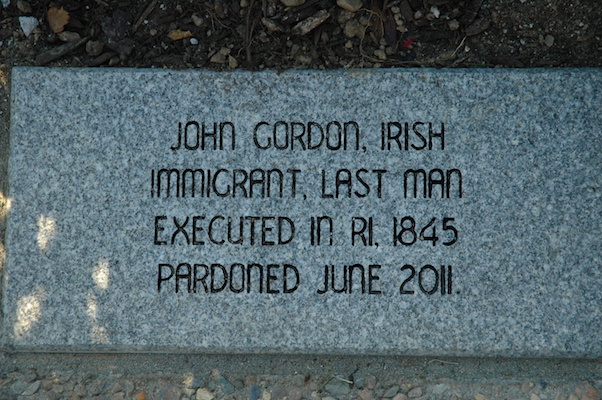
The Dorr War was re-enacted as farce a year later when an Irish saloon-keeper was charged with the infamous murder of Cranston textile baron William Sprague. The trial was as much an indictment of the Irish as of the defendant, John Gordon.  Prior to his client’s conviction on circumstantial evidence, Gordon’s lawyer said to a jury, “There may be those among you, who think there is little difference between taking the life of a dog and that of an Irishman.” In 1845, Gordon would be the last person executed in Rhode Island.   The Catholic priest who accompanied him to the gallows promised him everlasting life among Ireland’s martyrs.  Although Rhode Island formally abolished the death penalty several years later because of lingering uncertainty about Gordon’s guilt, discrimination continued unchecked. 
 
After the Civil War, during which two local Irish-American soldiers won the Congressional Medal of Honor, voters repeatedly refused to give naturalized veterans the franchise.  Not until the Bourn amendment to the state constitution in 1888 did the Republican political machine cynically liberalize voting laws.
 
Despite the new status, poverty remained widespread.  ” Help wanted” ads in local newspapers still carried the sting of  “No Irish Need Apply.”  Under relentless attack, [the Irish] banded together — only to be further denigrated for their “tribal instincts.”  To escape religious bias in public schools they founded a string of parochial academies.  Politically, with nowhere else to go, Irish-Americans gravitated to the discredited, formerly pro-slavery, Democratic Party, transforming it into an effective competitor against the corrupt Republican machine.  By the dawn of the 20th Century, the Irish finally edged ahead.  A new Hibernian constellation of political figures, weaned on the legend of the Irish diaspora but trained in American ways, broke the final barriers and eventually filled every political office in the state at one time or another.
 
Today most Irish-Americans’ grasp of their ancestry revolves around their surname or a glossy coat-of-arms. We Irish have been homogenized and sanitized, becoming part of the establishment that once rejected us as alien.  Now we’ve forgotten our own roots.  And that’s a shame!
 
On his Celtic headstone, P.J. McCarthy recounted the family’s plebian flight: “forced from home by landlordism and the penal laws.” He thanked the United States for accepting immigrants such as himself but pleaded: “May their history be written that future generations may learn of the heroic efforts and suffering of Irish Catholics at home and abroad for faith and fatherland.”  To truly dignify our past we must resolve to keep our heritage alive as Mayor McCarthy wished. 
 
(Note: Dr. Scott Malloy is a professor at the University of Rhode Island’s Labor Research Center.  The original, full-length version of this essay appeared on page B 5 in the March 17, 1997 edition of the Providence Journal.  The foregoing piece was edited, with the author’s permission, by Dr. Donald D. Deignan.) 


SUGGESTIONS FOR FURTHER READING
 
(Since the original production of “A State of Hope in 1995-1996, the “historiography” of the Famine (historical writing on that subject) has expanded markedly in quantity and in quality.  Most of the older books listed below are available in local public libraries.  Many of the more recent ones can be obtained commercially and in paperback form.  The latter are marked with an asterisk.  The best single volume about the Great Famine is that by James S. Donnelly, Jr.)
 
Beckett, J.C.   The Making of Modern Ireland, 1603-1923.  New York: Knopf,  1973.
 
Bourke, Austin.   'The Visitation of God'?: The Potato and the Great Irish Famine.  Dublin: Lilliput Press, 1993.
 
Coogan,, Tim Pat, Wherever Green Is Worn: The Story of the Irish Diaspora . * New York:  Palgrave (St. Martin’s Press), 2001.
 
Donnelly, James S., Jr.  The Great Irish Potato Famine.  Phoenix Mill,* Gloucestershire,  U.K.:  Sutton Publishing Limited, 2001.
 
Edwards, R. Dudley; Williams,  T. Desmond.  The Great Famine: Studies in Irish History,  1845-52. Dublin: Lilliput Press, 1994.*
 
Engels, Fredrish, The Condition of the Working-Class in England in 1844. New York: Hard Press, 2006.*  
 
Foster, R.F.   Modern Ireland: 1600-1972. New York: Penguin, 1990. 
 
Freeman, T.W.   Pre-famine Ireland: A Study in Historical Geography.  Manchester: Manchester University Press, 1957.
 
Kinealy, Christine.   This Great Calamity:  The Irish Famine 1845-52.  Dublin:* Boulder, CO: Robert Rinehart Publishing,  1997.
 
Laxton, Edward.   The Famine Ships:  The Irish Exodus to America.  New York:*  Henry Holt and Company, 1996.
 
Lyons, F.S.L.   Ireland Since the Famine.  Collins Fontana, 1973, 1971.*
 
Miller, Kerby.  Emigrants and Exiles:  Ireland and the Irish Exodus to North       America. New York: Oxford University Press, 1985.*
 
Mitchell, John; (Edited by Maume, Patrick.)  The Last Conquest of Ireland (Perhaps)* Dublin: Dublin University Press, 2005.
 

O’Grada, Cormac.  Black ’47 and Beyond: The Great Irish Famine in History, Economy, and Memory.  New Jersey: Princeton University Press, 1999.*

Percival, John.   The Great Famine:  Ireland's Potato Famine 1845-51.  New York::Viewer Books, 1995.

Woodham-Smith, Cecil.   The Great Hunger:  Ireland 1845-1849. London: Penguin Books, 1991, 1962.*Revised 5/12/07